Findings from OLL1073R-1 and OLS3059 lactic acid bacteria research(5)
Yogurt fermented with OLL1073R-1 and OLS3059 lactic acid bacteria has been confirmed to increase salivary IgA levels in response to influenza A (H3N2) (human study conducted in seniors in 2014).
This placebo-controlled double-blind parallel-group comparison study*1 was conducted, in collaboration with Kanagawa Dental University, at two special nursing homes for the elderly in Kanagawa Prefecture from October through December 2014. It involved a subject pool consisting of 96 seniors living in the homes.
Half of the subjects consumed 100 g of yogurt fermented with OLL1073R-1 and OLS3059 lactic acid bacteria once per day, while the other half consumed placebo yogurt in the same amount and with the same frequency, every day during the 12-week period. Then, changes in the amount of salivary IgA*2 that reacts to influenza A (H3N2) were compared between the two groups. The subjects in both groups were given influenza vaccines in early November, roughly 5 weeks after initiation of the study.
- *1: This is a type of study in which an experimental food and a placebo food are given to the subjects under identical conditions.
As both the subjects and the on-site study administrators are not given information that would enable them to distinguish between the two foods being provided (i.e., double-blind study), the result of the study is not affected by any bias that they may have.
- *2: This is a type of antibody in the immune system.
IgA (Immunoglobulin A) is mainly present in the oral cavity, nose, eyes, digestive tract, and other mucus membranes, and has the function of preventing viruses, bacteria, and other foreign particles from entering the body. Between 50 and 100 mg of IgA per day is known to be secreted in the oral cavity alone, and IgA accounts for a very high ratio of the entire immune function there.
In-saliva IgA that reacts to influenza A virus subtype H3N2 increased (higher rate of change)
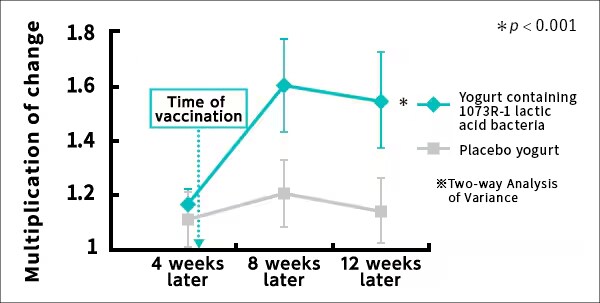
The results showed that the group that consumed yogurt fermented with OLL1073R-1 and OLS3059 lactic acid bacteria had significantly higher levels of IgA that react to influenza A (H3N2) virus compared to the placebo group. This means that it was not just that levels of IgA increased, but that the increased IgA had the ability to fight against influenza viruses.
Subject
pool |
Seniors living in special nursing homes or elderly health and welfare facilities in Kanagawa Prefecture |
| Number of subjects |
96 |
| Amount |
Group consuming yogurt fermented with OLL1073R-1 and OLS3059 lactic acid bacteria: 100 g/day
Group consuming placebo yogurt: 100 g/day |
| Period of consumption |
12 weeks |
Study
period |
October–December 2014 |
(Source: Yamamoto Y, et al. Acta Odontol Scand. 2019; 77(7): 517-24.)