|
Top page > Forefront of lactic acid bacteria research > About OLL1073R-1 and OLS3059 lactic acid bacteria > Findings from OLL1073R-1 and OLS3059 lactic acid bacteria research(1)
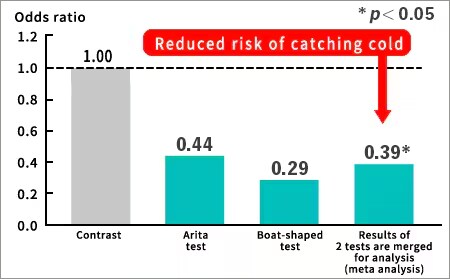
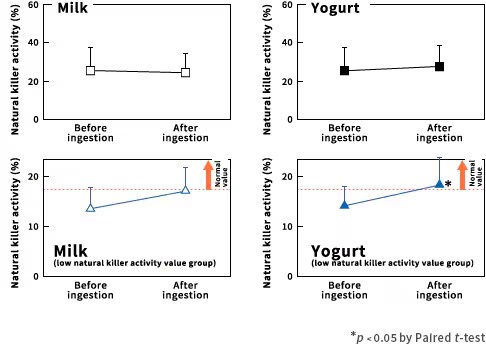
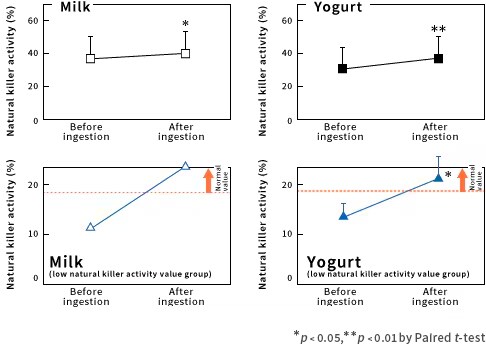
Findings from OLL1073R-1 and OLS3059 lactic acid bacteria research(1)Yogurt fermented with OLL1073R-1 and OLS3059 lactic acid bacteria has been confirmed to reduce the risk of catching the common cold and enhance NK activity (human study conducted in seniors from 2005 to 2007).A study was conducted in 57 healthy seniors (69-80 years old) living in Funagatamachi, Yamagata Prefecture, and 85 healthy seniors (59-84 years old) living in Aritacho, Saga Prefecture, in order to investigate the effects of lactic acid bacteria on the immune system. Each of these regional subject pools was divided into two groups. One group consumed 90 g of yogurt fermented with OLL1073R-1 and OLS3059 lactic acid bacteria per day. The other group consumed 100 ml of milk per day. The subjects in Funagatamachi and Aritacho were kept on this dietary regimen for 8 and 12 weeks, respectively, then, changes in their physical conditions and immunity were compared. For both regions, the groups consuming yogurt fermented with OLL1073R-1 and OLS3059 lactic acid bacteria had a significant*1 increase in the ability to produce T cells, which tends to decline with age. Furthermore, in the groups consuming the yogurt in both regions, subjects with low NK activity before the consumption experienced significant increase in NK activity. In addition, the risk of catching the common cold was reduced in the yogurt-consuming groups. If the risk of catching the common cold in the milk-consuming group is 1, the risks in the groups consuming yogurt fermented with OLL1073R-1 and OLS3059 lactic acid bacteria in Aritacho and in Funagatamachi were 0.44 and 0.29, respectively. With these two risks combined for analysis, the weighted average risk is 0.39, indicating a significant reduction in the risk of catching the common cold. *This means that the experiment was statistically proven to be effective. As it is common to apply p<0.05 as the level of significance (i.e., less than 5% chance of sampling data 100 times and finding different results), this level was used in this study. A human-subject study verifies the efficacy of OLL1073R-1 and OLS3059 lactic acid bacteria in reducing the risk of cold infectionYogurt fermented with OLL1073R-1 and OLS3059 lactic acid bacteria enhanced the activity of NK cells and reduced the risk of infection with the common cold.
Result of the study conducted on NK activity in Funagatamachi, Yamagata Prefecture
Result of the study conducted on NK activity in Aritacho, Saga Prefecture
(Source: Makino S, et al. Br J Nutr. 2010;104(7):998-1006.) |