|
Top page > Forefront of lactic acid bacteria research > About OLL1073R-1 and OLS3059 lactic acid bacteria > Findings from OLL1073R-1 and OLS3059 lactic acid bacteria research(2)
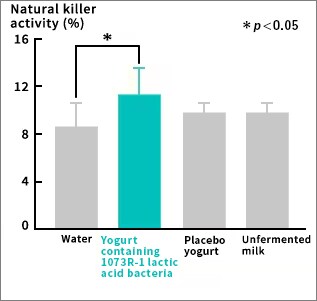
Findings from OLL1073R-1 and OLS3059 lactic acid bacteria research(2)Yogurt fermented with OLL1073R-1 and OLS3059 lactic acid bacteria has been confirmed to enhance NK activity (animal study conducted in 2005).
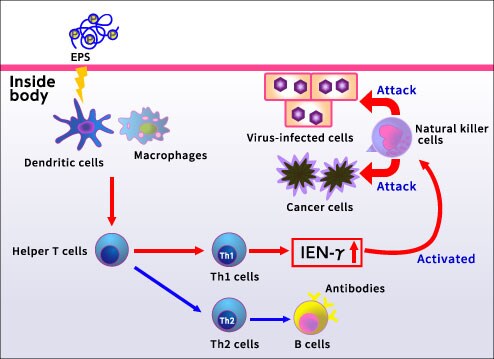
OLL1073R-1 and OLS3059 lactic acid bacteria produce polysaccharides (EPSs). When yogurt fermented with OLL1073R-1 and OLS3059 lactic acid bacteria was administered to the spleen cells of mice (i.e., cell population consisting of various immune cells), it was found to send signals to produce IFN-γ*1, which is an immune messenger. *1: IFN-γ (interferon gamma) is a type of cytokine secreted by T cells that activates macrophages and NK cells and enhances immune strength. It was confirmed that NK activity was increased in an animal study.Yogurt fermented with OLL1073R-1 and OLS3059 lactic acid bacteria increased NK activity.
(Source: Makino S, et al. J Dairy Sci. 2006;89(8):2873-81.) Mechanism of NK activity
EPSs have an IFN-γ production-inducing function, while IFN-γ activates NK cells.
|