










Results of research on OLL2716 lactic acid bacteria (in relation to Helicobacter pylori)
Research shows that consumption of yogurt containing OLL2716 lactic acid bacteria reduces Helicobacter pylori.
In a joint study with Tokai University’s School of Medicine, a trial was conducted on 30 people infected with Helicobacter pylori. The subjects were first fed yogurt not containing OLL2716 lactic acid bacteria (90 g per package) twice a day for eight weeks, after which they were fed yogurt containing OLL2716 lactic acid bacteria (90g per package, each containing 1 billion OLL2716 lactic acid bacteria) twice a day for eight weeks. When the subjects were subsequently examined, the activity of Helicobacter pylori in the subjects was suppressed after the consumption of yogurt containing OLL2716 lactic acid bacteria, while their gastric inflammation also improved.
In summary, research indicates that ingestion of OLL2716 lactic acid bacteria over a certain period suppresses Helicobacter pylori activity and mitigates Helicobacter pylori-induced gastric inflammation, as evidenced by this published study on the effect of OLL2716 lactic acid bacteria on human subjects.
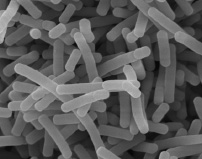
Electron microscope image of OLL2716 lactic acid bacteria
Ingestion of OLL2716 lactic acid bacteria in combination with other treatment method to eradicate Helicobacter pylori has proven to be effective.
In response to the problem of declining eradication rates due to the emergence of bacteria resistant to conventional antibiotics, the university confirmed in 2009 that OLL2716 lactic acid bacteria effectively eradicated resistant bacteria, including clarithromycin-resistant Helicobacter pylori, in combination with eradication therapies.
In the study, a total of 229 Helicobacter pylori-infected subjects were divided into two groups. The first group was subjected to regular bacteria eradication treatment (administering three different antibiotics), while the second group took yogurt containing OLL2716 lactic acid bacteria (90 g per package, twice a day) for three weeks before receiving the same treatment as described above and also for one week during the treatment period (for a total of four weeks). When the two groups were later compared, the success rate of bacteria eradication was higher for the second group that had both the yogurt and the treatment than the first group that only had the treatment, by roughly 10%, which is a significant improvement.
What is the Helicobacter pylori bacterium that is known to cause stomach cancer and ulcer?
- Recap on OLL2716 lactic acid bacteria
- ■Point 1
OLL2716 lactic acid bacteria attack Helicobacter pylori, the cause of gastric ulcers and stomach cancers!
■Point 2
Yogurt containing OLL2716 lactic acid bacteria suppresses the activity of Helicobacter pylori in the stomach!